
The United States' war in Iran has heightened existing concerns among some service members about the influence of Christian nationalism on the military under Pentagon chiefPete Hegseth's leadership.
The country began carrying outjoint strikes with Israelon Feb. 28 thatkilled Iran's Supreme Leader Ayatollah Ali Khamenei.At least1,230 people had been killed in Iranas of March 5, along with scores of other deaths around the Middle East.
Mikey Weinstein, founder and president of the Military Religious Freedom Foundation, told USA TODAY on March 4 the organization had received "far greater than" 200 complaints related to religious freedom from service members across more than 50 military installations since the war broke out.
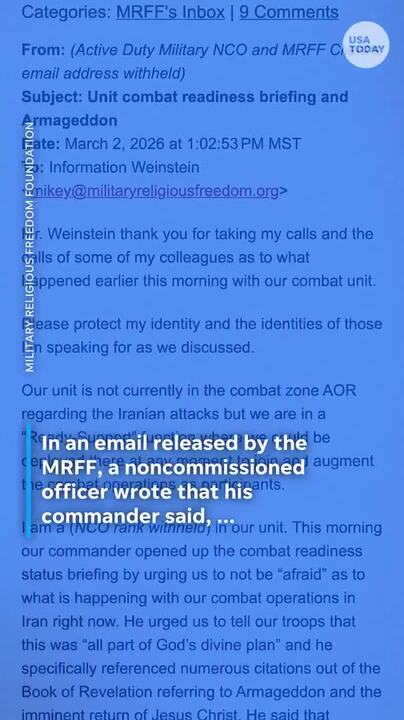
One such complaint allegedthat a commander told non-commissioned officers in a March 2 briefing that PresidentDonald Trumpwas "anointed by Jesus to light the signal fire in Iran to cause Armageddon and mark his return to Earth."
The Pentagon did not respond to USA TODAY's inquiries as to whether it investigated or verified the complaint, nor whether commanders are permitted to make such comments to subordinates under Hegseth's leadership.
Hegseth has touted an explicitly religious vision for the military, demonstrated through efforts such asmonthly Christian worship services at the Pentagonand speeches likeone at the National Religious Broadcasters conventionin Nashville, in which he said, "The virtues (Christianity) extols are not just for the sanctuary but for the public square."
In interviews with USA TODAY, retired military chaplains and a leading expert on faith in the armed forces said such efforts mark a shift from how the Pentagon has approached religion in the past. More overtly Christian messaging could diminish cohesion by alienating those without such beliefs, they said.
Hegseth echoes Trump administration's focus on religion
The Pentagon referred USA TODAY to a video Hegsethposted to Xin December, in which he described a perceived "weakening of our Chaplain Corps" as "a real problem facing our nation's military." USA TODAY had requested an interview about the chaplaincy program and provided a list of questions about religion and the military.
In the video, Hegseth lamented what he said was the military's misguided shift away from explicit references to God in favor of broader spirituality over the years. There was only one reference to God in the Army's spiritual fitness guide, Hegseth said, adding that the document would be disregarded moving forward.
Hegseth citedthe words of President George Washington, whoestablished the Chaplain Corps in 1775: "The blessing and protection of Heaven are at all times necessary, but especially so in times of public distress and danger."
Hegseth's comments reflect the Trump administration's broader tone and efforts to boost religion's presence in the public square.
Trump touted what he described as a "tremendous renewal in religion, faith, Christianity and belief in God" in the countryin his 2026 State of the Union address.
Members of Trump's Religious Liberty Commission have also expressed a belief thatthe establishment clauseof the First Amendment doesn't prevent the government from promoting religion and that it can and should do so.
A group of organizationssued the commission in February, alleging that it has an illegal lack of religious and ideological diversity. The commission is composed of "almost exclusively Christians with one Orthodox Jewish Rabbi," according tothe federal complaint.
Trump alsovowed to protect prayer in public schoolsat a Religious Liberty Commission hearing in September, saying at one point in his speech that, "To have a great nation, you have to have religion."
A 'wrecking ball' to chaplaincy's purpose
The U.S. military has historically moved toward a more pluralistic treatment of religion over time, though there have long been debates and controversies over issues of religious freedom, according toRonit Stahl, a University of California Berkeley professor and author of the book, "Enlisting Faith: How the Military Chaplaincy Shaped Religion and State in Modern America."
Thechaplaincy was exclusively Protestantat its founding but introducedCatholic chaplains and a rabbiin the 19thcentury. Thefirst Muslim chaplaincame in 1994, and thefirst Buddhist chaplainfollowed in 2008.
TheU.S. Supreme Court in 1986ruled that the Air Force could prohibit an Orthodox Jewish service member from wearing a yarmulke while in uniform. Though it restrained his religious expression, the court said the ban "reasonably and evenhandedly" supported the military's "perceived need for uniformity."
Stahl also pointed to controversy in the early 2000s overallegations that Air Force Academy officersand cadets were proselytizing in support of evangelical Christian beliefs, fostering a less welcoming environment for service members of other faith traditions.
It was around that time that Weinstein founded the Military Religious Freedom Foundation. The organization has represented more than 100,000 military members in various religious freedom matters in the years since then, Weinstein said, adding thataround 95% of the organization's clientsare Christian.
Army Chaplain Corps guidelinespublished during former PresidentJoe Biden's administration in February 2024, whichremained on the Army's websiteas of early March, said the Chaplain Corps at that point represented more than 100 religious groups.
Advertisement
The Chaplain Corps "cares for all Soldiers and their Families, regardless of their religious preferences, and even when they have no religious preference at all," it said. It added that recruiters were "actively working to increase the Corps' diversity" at that point, particularly as it related to more women serving as chaplains and more representation of minority faiths in the chaplaincy.
Rabbi Joel Schwartzman, a client of the Military Religious Freedom Foundation who served for more than 20 years as an Air Force chaplain and retired as a full colonel, said Hegseth's efforts "fly in the face of the whole purpose of the chaplaincy."
TheAir Force's recruiting websitesays a "diverse chaplain corps is crucial" to meet service members' spiritual needs in a "culturally, racially and religiously diverse environment."
"He's bringing a wrecking ball to that purpose," Schwartzman said.
Concerns over unit cohesion, morale
Schwartzman and other retired military chaplains told USA TODAY they worried about the impact of Hegseth's more narrow religious vision on unit morale and cohesion, saying his efforts stand in stark contrast to how they approached their service.
Steve Dundas, a retired Navy commander with nearly 40 years of military service and around 30 years as a military chaplain, described sending emails with "inspirational" messages to service members. They centered on faith broadly as opposed to making specific references to God, he said.
"They were so ecumenical, almost anybody could find something that they like," he said.
He also worked to provide specific resources spanning an array of religious traditions, which he said included Islam, Judaism and Wicca.
Dundas, who is also a client of the Military Religious Freedom Foundation, doesn't see the same priorities under Hegseth's leadership. He specifically referenced a worship service led by Pastor Doug Wilson, whopromotes Christian nationalism, the belief that America is or should be a Christian nation, and hasargued against women's right to vote, at the Pentagon in February.
Wilson leads the Communion of Reformed Evangelical Churches, thedenomination that includes the Tennessee church Hegsethhas attended.
"Unless you're somebody that's of that group, you're going to be very, very uncomfortable, and traditionally, that's not the way chaplains have served," Dundas said.
Military hierarchy makes it harder to speak out
Though the Pentagon has said service members' attendance at such events ispurely voluntary and not tracked,retired personnel said the military's hierarchical structure creates pressure to attend events promoted by superiors even if they are characterized as optional.
Weinstein described it as being "voluntold."
"Your military superior is not your manager at Starbucks or Taco Bell," he said. "They have complete and total control over your life."
He referencedthe Uniform Code of Military Justice, the military's criminal code, which places more restrictions and harsher punishments on service members than they would face as civilians.


Pete Hegseth: See the combat veteran's career from Fox News to Secretary of Defense
A culture of deference to authority and harsh punishments for stepping out of line make it risky for current service members to express concerns, Weinstein said. That's where he sees his organization making a difference by publicly raising such issues while shielding service members from potential retribution.
Suing the Trump administration over such matters would require a willing plaintiff, and he said those directly impacted by Hegseth's actions are unlikely to pursue that option. Stahl agreed, saying that service members doing so would be "pretty extraordinary given the potential repercussions."
A group ofmilitary parents did sue the Pentagonin 2025 over removing certain materials from schools operated by the Department of Defense because of perceived "wokeness." In October, a district judgeordered the administration to reinstatethe materials while litigation over the matter continues.
BrieAnna Frank is a First Amendment reporter at USA TODAY. Reach her atbjfrank@usatoday.com.
USA TODAY's coverage of First Amendment issues is funded through a collaboration between the Freedom Forum and Journalism Funding Partners.Funders do not provide editorial input.
This article originally appeared on USA TODAY:Iran war fuels Christian nationalism concerns in U.S. military